Blog

  • LEARN with ORCA

    LEARN with ORCA

    Earth day is a cursed experience, usually. Like pride month but for the planet, it provides an opportunity for companies to post hypocritical propaganda while continuing their path of exploitation. ANYWAY, we’ve chosen today to start a new thing called LEARN with ORCA.

    The idea is that we’ll go out and learn things, and then post about them to share with our friends.


    Today’s question

    The first ever Learn with ORCA asks: What if universities supported resistance movements?

 We’ve been wondering this since we started our campaign against Cambridge Institute for Sustainability Leadership (CISL). CISL is one of the uni’s main points of contact with the world on issues of environmental action and policy. How do they choose to engage? By building partnerships with some of the worst companies in the world!

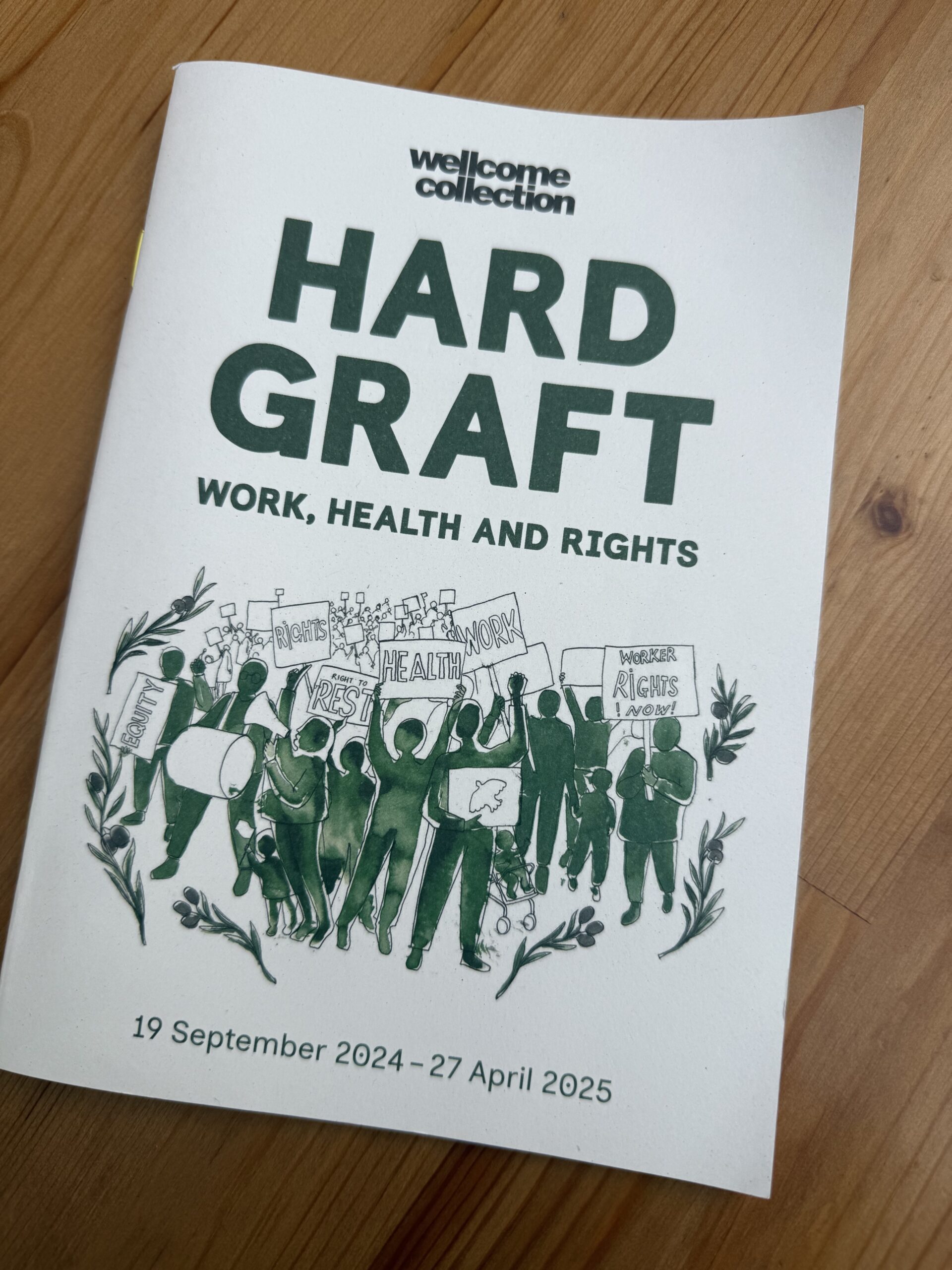
    What’s the alternative? Can we imagine what it would look like if universities put their skills and clout into the service of resisters, not oppressors? At the Wellcome Collection’s Hard Graft exhibition we found an example of academics doing exactly this.

    Hard Graft

    The exhibition itself was good – despite Wellcome’s very dodgy history, their public work is pretty insightful these days. It covered the history of work in plantations, prisons, the street and the home. We really liked the clarity with which it linked plantations and prison labour, although it could have done more to show that exploitative prison labour isn’t just a US problem. In the UK, the British Legion poppies are made by prisoners on near-zero wages, for example. We also liked the attention the exhibition gave to sex workers and sanitation workers.

    In one room marked “the Post-plantation”, a film was showing about “Cancer Alley” in Louisiana. Cancer Alley is a stretch of land along the Mississippi River, where plantations have been replaced with highly-polluting corporations. The majority-Black communities (including those descended from enslaved people) who live in the area are facing high rates of illness and low life expectancies because of the air, water and land pollution. This is an example of environmental racism, where environmental harm is concentrated in areas inhabited by Black and Brown people because in white supremacy Black and Brown bodies are valued less than white ones. It is not accidental that present-day environmental violence is overlaid on the sites of plantations, where enslaved people were subjected to so much violence in the name of profit.

    The film showed how people are resisting this violence today. One resistance group is called Rise St. James, who are fighting petrochemical expansion in St. James Parish, Louisiana. It was quite an emotional film to watch – they’ve shown the injustice very clearly. We were excited to see how Rise St. James are working with academic institutions to create evidence against the polluters. One paper by Kimberly A Terrell and Gianna St Julien at Tulane University has demonstrated the impact of industrial emissions on the health of racialised and impoverished communities.

    Forensic Architecture

    The most exciting thing for us was a study created by Forensic Architecture at Goldsmiths University. They’ve created a portal where you can see air pollution data in the present day, and also overlays of former plantations. The point of including the historic data is to identify the sites of Black cemeteries – these in theory should be protected, and so identifying the sites gives Rise St James a stronger base from which to push back against petrochemical expansion. Sadly, many of these sites have been erased. Forensic Architecture are aiming to recover them by finding anomalies on modern-day aerial maps and comparing those to historical plantation maps. You can find the portal here: https://louisiana.forensic-architecture.org/

    Forensic Architecture are exactly the kind of thing we were looking for. On their website they say “We investigate states and corporate entities—including militaries, police forces, government agencies, and companies—for their violent acts, including repressive policing, civilian deaths in conflict, structurally racist policy-making, violence against migrants and refugees, and historical and contemporary colonial violence, including the destruction of traditional environments and life worlds.”


    In a time where students are being abducted and deported without trial, where academic freedom on the issues of Palestine, racism and environmental injustice is under even greater attack than usual, it’s cool to see a space where academics are so directly supporting resistance movements. They’ve worked on Grenfell, on German colonial genocide in Namibia, on Hind Rajab’s death and on mapping Israel’s conduct in Gaza. The point is not just to record but to support resistance.

    So what does any of this mean?

    1. There’s an alternative to corporate engagement – universities can create ways to lend their clout, knowledge and skills to resistance movements (rather than collaborating with the oppressors).
    2. Even when universities do support resistance movements, the drive and power comes from people on the ground. Without the leadership and energy of Rise St. James, none of this would matter.
  • Press release – Cambridge sustains green colonialism

    Press release – Cambridge sustains green colonialism

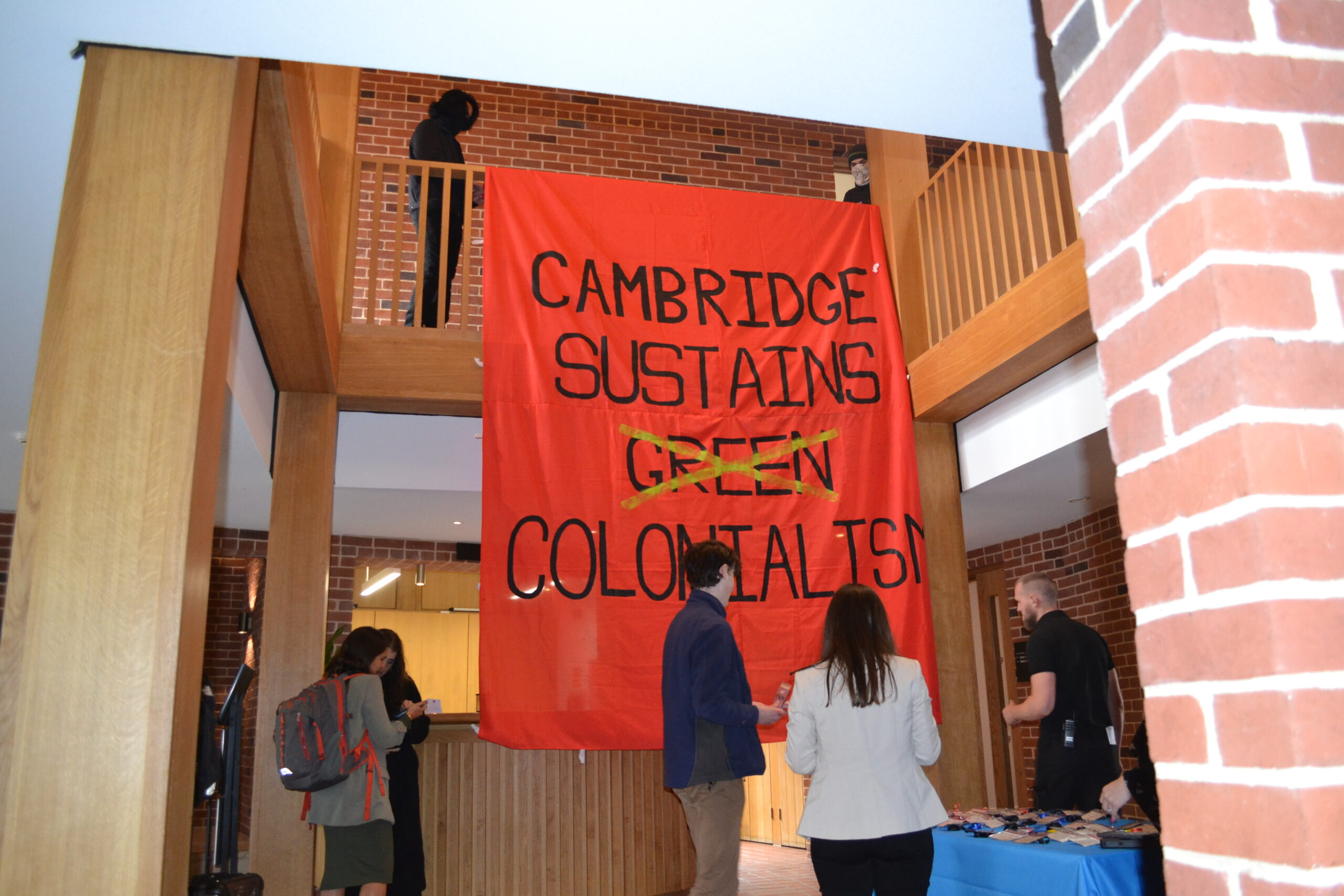
    Today we are disrupting The Nature Action Dialogues conference hosted at Jesus College.

    This conference is hosted by the UN Environment Programme World Conservation Monitoring Centre (UNEP-WCMC)  and their Proteus Partnership and listed attendees include Ipieca, HSBC, Drax, Nestle, AngloAmerican and RWE.

    Through the Proteus Partnership the UN helps oil and gas and mining companies to greenwash their harmful extractive practices whist providing no real influence on the behaviour of these companies. This is evidenced from BPs recent rollback of their climate and renewables targets.

    Members of the Proteus Partnership include BP, Shell, Total Energies, Chevron, RioTinto, Equinor and AngloAmerican. 

    Drax power station has also just been granted huge new subsidies for burning trees despite recording massive profits. Drax’s wood burning is classed as ‘renewable’ energy despite being the UK’s largest carbon emitter and the worlds largest wood burning power station. Almost all of the wood burned at Drax is imported and has included old growth forest wood from Canada and wood from protected forests in Estonia

    By continuing to pretend that companies like those directly or indirectly represented at this conference will sacrifice profits and power to act on the climate and to stop the harm they are causing globally Cambridge is sustaining ecocide, neo-colonial violence, land theft and human rights violations world wide. 

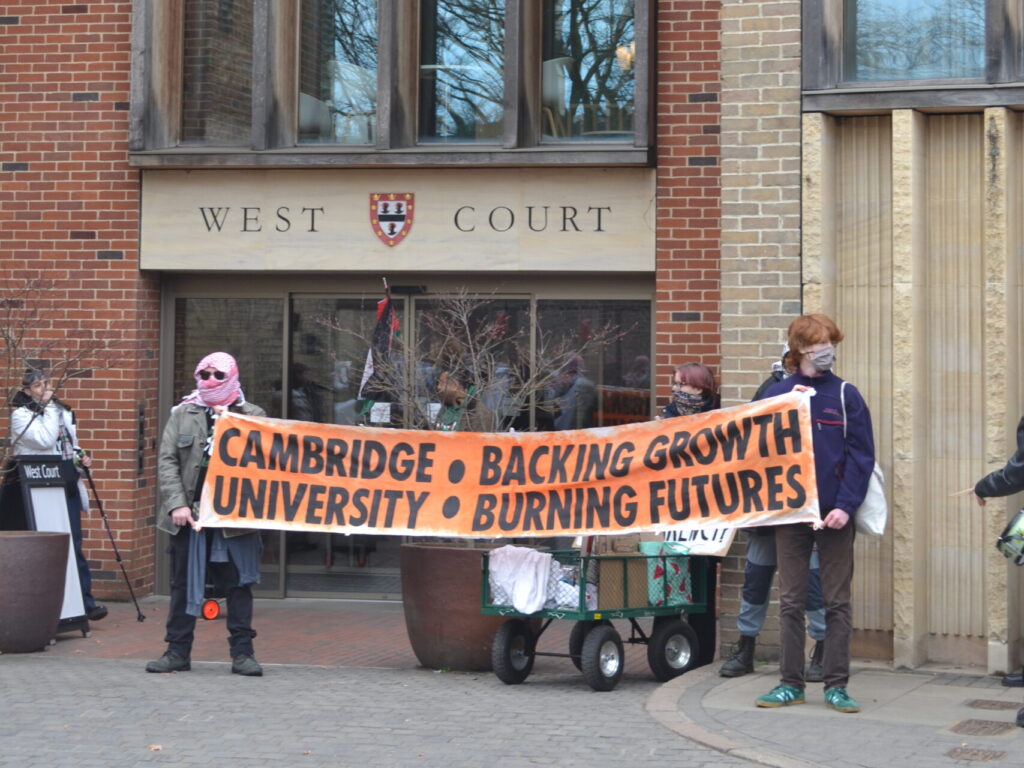
    On this theme, today ORCA is launching our new campaign against CISL (Cambridge Institute for Sustainability leadership), the university’s greenwashing outfit. CISL works with many of the harmful corporations here today and many more and is responsible for supporting and sustaining the harm they have caused and are causing today through lending them the perceived prestige of Cambridge University and giving the appearance of caring about climate collapse.

  • Why eat the rich? Climate Change and Class War

    Why did we stick anti-rich posters up all over Cambridge?

    The Multi-generational Leadership Course

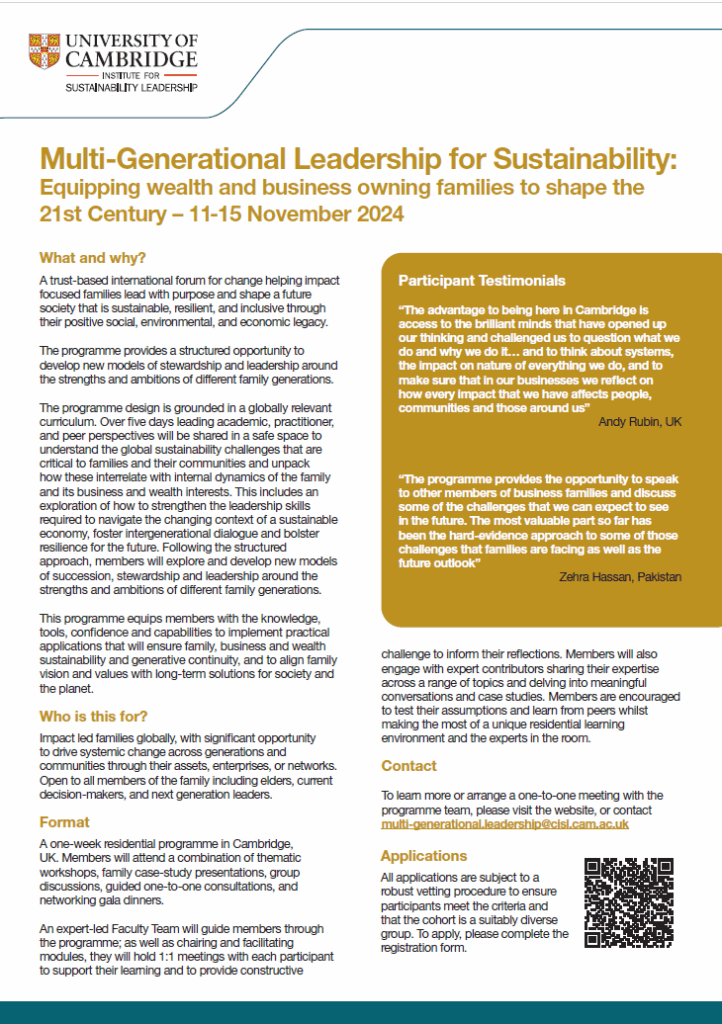
    From the 11th of November till the week’s end, the Cambridge Institute for Sustainability Leadership will be running their week-long ‘multi-generational leadership program’. Costing almost £13k a head, the course promises to teach ‘wealth and business owning families‘ how to sustain… something [hint: themselves] into the future and “shape the 21st century”.

    Leaflet for the event. See source or archived version for full text.
    Leaflet for the event. Published by CISL. [source, archived on 2025-04-20]

    COP29

    Also starting on the 11th is the 29th COP – a global meeting about the climate crisis. Despite meeting regularly for decades, COP has done little to turn around the worsening environmental and climate crises. This is because it is structurally incapable of addressing the issues that underlie these crises, namely capitalism and neo-colonialism. Indigenous, poor and decolonial voices are sidelined, while oil companies, mega-corporations and colonial powers control the proceedings. 

    This year, the President of COP has been caught using the conference as an opportunity to discuss new oil and gas deals. The host country, Azerbaijan, is also throwing climate journalists in jail ahead of COP.

    29th Anniversary of the killing of the Ogoni 9

    On the 10th of November it was the 29th anniversary of the killing of the Ogoni 9 at the hands of the Nigerian government and the oil company Shell. You can read more about it here.

    The experience of the Ogoni 9 and the resistance they were part of teaches us to be very critical about the relationship between land, power and environment. In 2023, the Movement for the Survival of the Ogoni People were part of the People’s Health Tribunal, which looked at the harm done by Shell and Total Energy across Africa. It recommended that movements “stop endorsing ‘green capitalism’ and the continued colonial extraction for renewable energy.” 

    We respond to this call by highlighting and resisting the green capitalism found in CISL’s program, which aims to sustain wealth hoarding and the exploitation that depends on.

    But more generally… what’s the problem?

    CISL’s program promotes a type of “bunker environmentalism” – that is, teaching those with power and wealth how to keep themselves safe through the multiple crises we are experiencing today. 

    Bunker environmentalism is a part of eco-fascism – the allying of violent authoritarian politics with environmentalism. You can find out more about eco-fascism here and here

    Don’t we need the rich people to change?

    Yes – we need them to stop hoarding their wealth. The rich will lead us to nothing but further pain – any effective action against climate and environmental harm will be led by the communities which have been most affected by the violence of extractivism, and which are currently experiencing the most immediate effects of climate and environmental crisis. 

    Aren’t Cambridge Institute for Sustainability Leadership on the good side?

    They definitely want you to think that. However, their work speaks for itself – here’s a short ‘best of’ list:

    At the end of the day, what CISL hopes to sustain is the status quo; with the rich on top, safe from climate change’s worst effects, and the global majority left to suffer the consequences of the rich’s actions.

  • How to spot Ecofascism

    How to spot Ecofascism

    The far right is opportunistic

    As climate breakdown becomes undeniable, they will exploit climate anxieties to push an agenda of hate. This isn’t someone else’s problem – far-right ideas can take hold in our own groups and movements. The narratives below normalise far-right framings and legitimise oppression, sowing seeds for more dangerous futures – ecofascist or otherwise. We have to expose far-right talking points and leave no room for co-option in our messaging.

    Here are some of their common talking points.

    Overpopulation

    The far right claims there are too many people for the Earth to support. This often leads to calls for reducing Global South populations. In mainstream climate groups, this idea can show up with comments like “there are just too many of us” or “birth control is a climate solution”. Remember that areas with higher birth rates or population aren’t responsible for the highest consumption – a billionaire’s carbon footprint is a million times the global average.

    Migration

    The far right claims borders protect the environment. Migrants, they say, are less able to care for nature and increase pressure on local ecology. Ecofascists also argue that we must act on climate to avoid migration. In mainstream groups, this can show up as discussions of a “migrant crisis” which don’t focus on the experiences of displaced people, or ideas of climate action being the remit of “civilised” countries.

    Authoritarianism

    The far right thrives in times of crisis, offering a strong leader to “protect the nation” – and in doing so crank up the oppression of minorities. This shows up in mainstream groups as appeals to the police, government or monarchy to suspend democracy to enforce climate measures on people in Britain and around the world.

    Save our children

    The far right claims the “white race” (symbolised by white children) is under attack. By claiming victimhood, the far right hides the overwhelming responsibility of rich countries and casts those most affected as the perpetrators. If you hear a lot of discussion about “saving our children” in your group, remember that people in the Global South (and marginalised communities in the North) are already dying – and have been for centuries of colonisation, extraction, air pollution, and police violence.

    Purity

    For the far right, “nature” is correlated with “purity”. They see People of Colour as “polluting white bloodlines”, and LGBTQ+ and disabled people as unnatural or impure. The idea of “pristine nature” is used to justify evicting Indigenous people from their lands for conservation projects. Purity narratives often show up in mainstream climate groups as a refusal to engage with “other issues” – insisting on climate-only messaging that doesn’t complicate the narrative.

    Collapse

    Some on the far right dream of an apocalyptic “survival of the fittest” scenario and may believe such collapse is inevitable. If someone says “catastrophic warming is locked in – all we can do is adapt”, remind them that many we care about aren’t able to do so.

    So how do we fight this co-option of our movement?

    The far right shifts blame onto marginalised people (especially migrants and peoAs Textple in the Global South) in order to justify further oppression as a solution. It is essential to recognise that it is these same systems of violence that created the climate crisis in the first place. Unconstrained fossil fuel extraction and combustion would not be possible, for instance, without the racism that treats those most impacted as disposable. Justice is not a distraction from the issue: it is the issue – and the one thing the far right cannot co-opt.

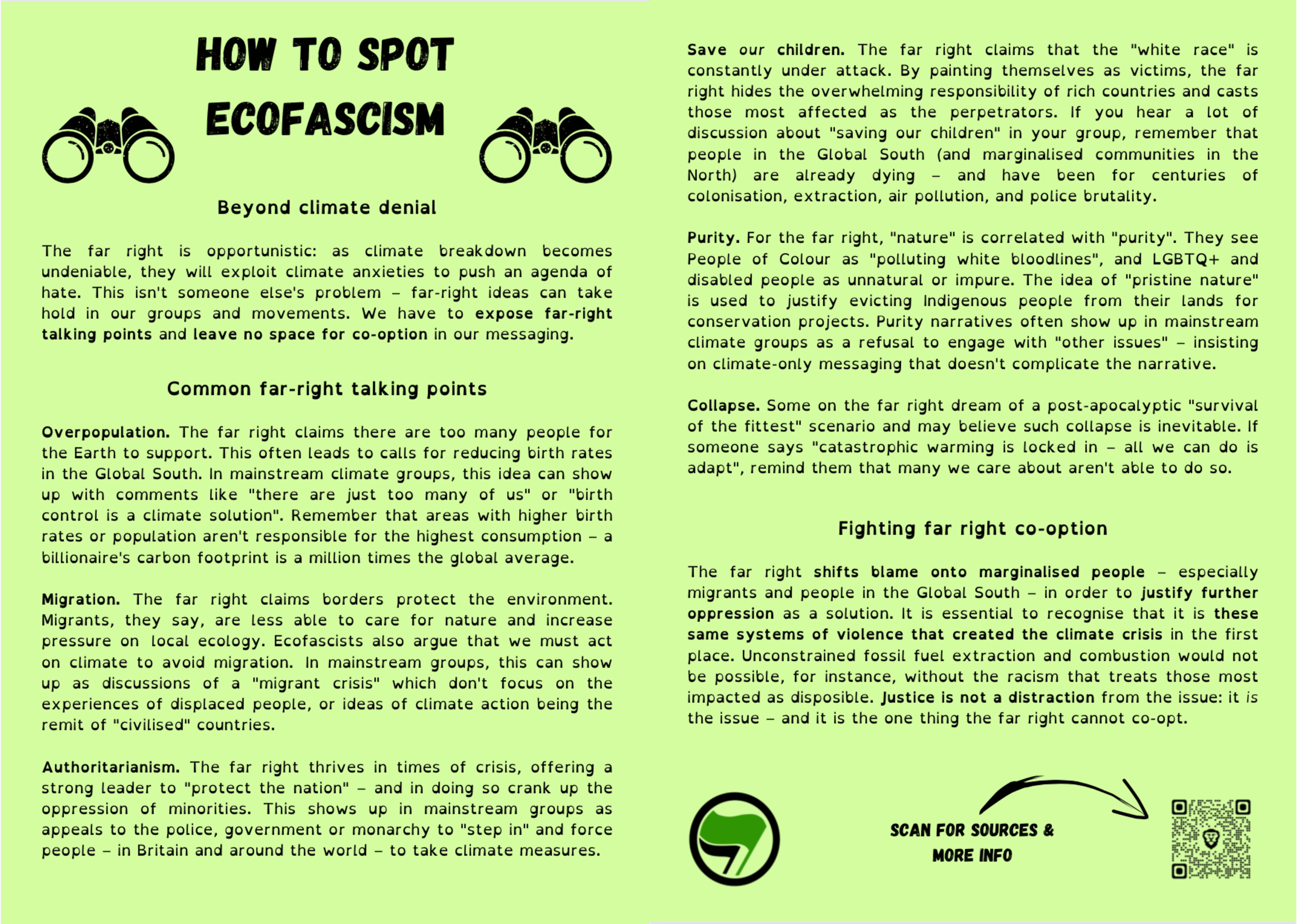
    Poster

    A poster defining far-right talking points used to co-opt environmental concerns to espouse fascist ideas
  • ORCA is born

    ORCA is born

    XR Youth Cambridge are now O.R.C.A. (Organisation of Radical Cambridge Activists)!

    For a long time, we have felt that our focuses, methods and politics have differed from XR UK. We have found we don’t closely align with XR in several ways, specifcially XR’s relationship with the police and the state has been a challenge. This is about reflecting the reality of our group, rather than signalling major changes to how we work. We will continue the SLB Out campaign with XR Cambridge and other groups, and are still happy to work with XR when our aims fit together. 

    Our name is a reference to the Orcas who are currently taking direct action against yachts. As kids, we were told to ‘save the whales’, but instead the whales are taking things into their own fins. We don’t think we’re saving the world: we’re part of the fight. We are also inspired by the way they are targeting the cause of environmental, economic and social crises – the super rich.

    We are staying youth-led but (again reflecting the reality of how we work) this will be a little bit of a softer boundary going forward. Several people have been ‘honorary’ members of the group because we align on politics and tactics, and we welcome their place in our work.

    Get in touch if you’d like to chat!

    If you’d like to get involved, our join form is here.

    Over the next few weeks we will be working to clarify our identity, processes and focuses for the future. As a decentralised and non-hierarchical group, everyone is empowered to take action, and there’s always space for new ideas.